

Fondren Road
Project Overview
Council District: K
Project Number: N-100008-0001 & N-100021-0001
Estimated Budget: $28,426,225
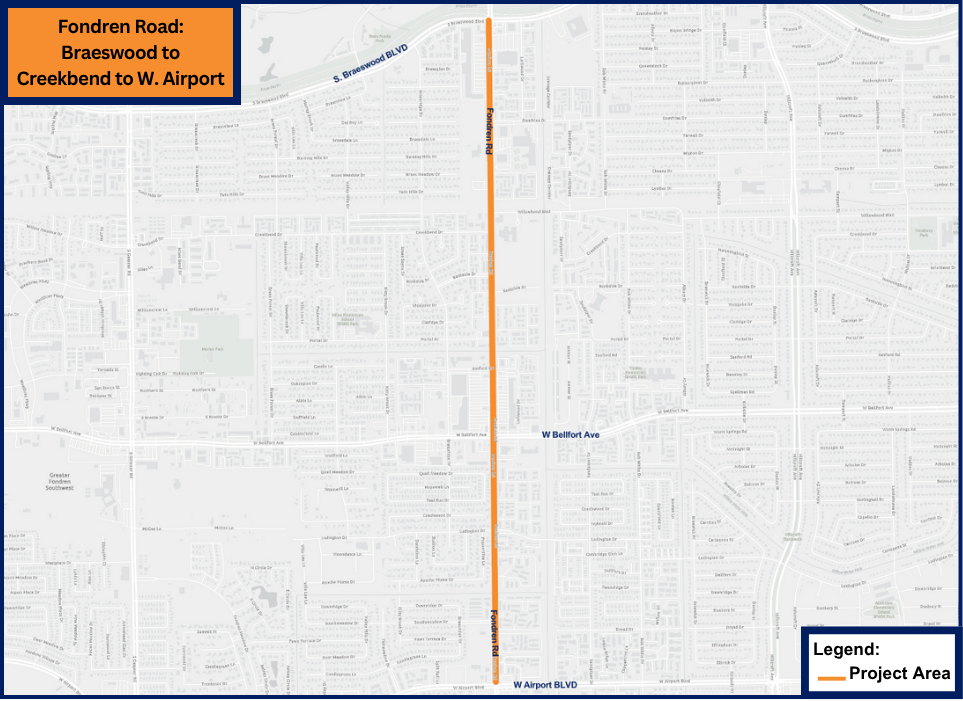
Project Impact Area
Community Feedback
Have questions or feedback about this project? Email us at engage@houstontx.gov or call 311.
Project Overview
Council District: K
Project Number: N-100008-0001 & N-100021-0001
Estimated Budget: $28,426,225
Project Impact Area
Community Feedback
Have questions or feedback about this project? Email us at engage@houstontx.gov or call 311.
Is there anything you want us to know?
-
Share Will the signal at the intersection of Fondren Road and South Braeswood Boulevard be included in this project? This is one of the busiest intersections in the corridor throughout much of the day, and the existing signal timing and phasing do not appear to adequately handle current traffic volumes. Despite multiple 311 reports over time, meaningful operational improvements have not been achieved. This suggests the intersection may require more than simple timing adjustments and could benefit from physical and operational upgrades as part of this project. Potential improvements such as increased left-turn lane storage, improved vehicle detection, and updated signal timing/phasing could significantly reduce queueing, improve throughput, and enhance overall safety and efficiency at this intersection. on Facebook Share Will the signal at the intersection of Fondren Road and South Braeswood Boulevard be included in this project? This is one of the busiest intersections in the corridor throughout much of the day, and the existing signal timing and phasing do not appear to adequately handle current traffic volumes. Despite multiple 311 reports over time, meaningful operational improvements have not been achieved. This suggests the intersection may require more than simple timing adjustments and could benefit from physical and operational upgrades as part of this project. Potential improvements such as increased left-turn lane storage, improved vehicle detection, and updated signal timing/phasing could significantly reduce queueing, improve throughput, and enhance overall safety and efficiency at this intersection. on X (formerly Twitter) Share Will the signal at the intersection of Fondren Road and South Braeswood Boulevard be included in this project? This is one of the busiest intersections in the corridor throughout much of the day, and the existing signal timing and phasing do not appear to adequately handle current traffic volumes. Despite multiple 311 reports over time, meaningful operational improvements have not been achieved. This suggests the intersection may require more than simple timing adjustments and could benefit from physical and operational upgrades as part of this project. Potential improvements such as increased left-turn lane storage, improved vehicle detection, and updated signal timing/phasing could significantly reduce queueing, improve throughput, and enhance overall safety and efficiency at this intersection. on Linkedin Email Will the signal at the intersection of Fondren Road and South Braeswood Boulevard be included in this project? This is one of the busiest intersections in the corridor throughout much of the day, and the existing signal timing and phasing do not appear to adequately handle current traffic volumes. Despite multiple 311 reports over time, meaningful operational improvements have not been achieved. This suggests the intersection may require more than simple timing adjustments and could benefit from physical and operational upgrades as part of this project. Potential improvements such as increased left-turn lane storage, improved vehicle detection, and updated signal timing/phasing could significantly reduce queueing, improve throughput, and enhance overall safety and efficiency at this intersection. link
Will the signal at the intersection of Fondren Road and South Braeswood Boulevard be included in this project? This is one of the busiest intersections in the corridor throughout much of the day, and the existing signal timing and phasing do not appear to adequately handle current traffic volumes. Despite multiple 311 reports over time, meaningful operational improvements have not been achieved. This suggests the intersection may require more than simple timing adjustments and could benefit from physical and operational upgrades as part of this project. Potential improvements such as increased left-turn lane storage, improved vehicle detection, and updated signal timing/phasing could significantly reduce queueing, improve throughput, and enhance overall safety and efficiency at this intersection.
Wannabehocker asked 3 months agoReady...Set...ENGAGE!
Thank you for your recommendation. Your suggestion has been noted, and we will consider whether integrating the nearby traffic signals at this intersection is appropriate as the project design continues to move forward.
- Engage Houston Team
-
Share One major operational pinch point along Fondren is the closely spaced intersections at Willowbend Boulevard and Creekbend Drive. Due to the short spacing and heavy traffic volumes, these intersections effectively function as a single complex intersection rather than two independent signals. The city needs to strongly consider placing all seven signalized approaches/phases within one integrated signal control cabinet or unified control system so the entire area can operate as a single coordinated network. This would allow signal timing, phase sequencing, offsets, and vehicle detection to be managed together rather than as separate intersections, improving synchronization and simplifying long-term maintenance and retiming. The current lack of coordination between these intersections already creates significant operational issues. Traffic progression is poor, and vehicles frequently clear one signal only to stop almost immediately at the next, causing unnecessary congestion, queue spillback, and delay. Just as importantly, because these intersections currently operate as separate systems, maintenance and timing complaints submitted through 311 are difficult to diagnose and resolve properly. Adjustments are made to one signal without considering the other, and they often fail to address the root problem. Treating this area as one integrated system would greatly improve both traffic operations and long-term troubleshooting. Additionally, the Exxon driveway signal at Willowbend should only be triggered by actual vehicle presence. Currently, that exit receives dedicated green time even when no vehicles are waiting, causing unnecessary delay for through traffic on Fondren and further disrupting progression between the Willowbend and Creekbend signals. Any driveway phase should be fully demand-based using reliable vehicle detection so green time is only allocated when needed. on Facebook Share One major operational pinch point along Fondren is the closely spaced intersections at Willowbend Boulevard and Creekbend Drive. Due to the short spacing and heavy traffic volumes, these intersections effectively function as a single complex intersection rather than two independent signals. The city needs to strongly consider placing all seven signalized approaches/phases within one integrated signal control cabinet or unified control system so the entire area can operate as a single coordinated network. This would allow signal timing, phase sequencing, offsets, and vehicle detection to be managed together rather than as separate intersections, improving synchronization and simplifying long-term maintenance and retiming. The current lack of coordination between these intersections already creates significant operational issues. Traffic progression is poor, and vehicles frequently clear one signal only to stop almost immediately at the next, causing unnecessary congestion, queue spillback, and delay. Just as importantly, because these intersections currently operate as separate systems, maintenance and timing complaints submitted through 311 are difficult to diagnose and resolve properly. Adjustments are made to one signal without considering the other, and they often fail to address the root problem. Treating this area as one integrated system would greatly improve both traffic operations and long-term troubleshooting. Additionally, the Exxon driveway signal at Willowbend should only be triggered by actual vehicle presence. Currently, that exit receives dedicated green time even when no vehicles are waiting, causing unnecessary delay for through traffic on Fondren and further disrupting progression between the Willowbend and Creekbend signals. Any driveway phase should be fully demand-based using reliable vehicle detection so green time is only allocated when needed. on X (formerly Twitter) Share One major operational pinch point along Fondren is the closely spaced intersections at Willowbend Boulevard and Creekbend Drive. Due to the short spacing and heavy traffic volumes, these intersections effectively function as a single complex intersection rather than two independent signals. The city needs to strongly consider placing all seven signalized approaches/phases within one integrated signal control cabinet or unified control system so the entire area can operate as a single coordinated network. This would allow signal timing, phase sequencing, offsets, and vehicle detection to be managed together rather than as separate intersections, improving synchronization and simplifying long-term maintenance and retiming. The current lack of coordination between these intersections already creates significant operational issues. Traffic progression is poor, and vehicles frequently clear one signal only to stop almost immediately at the next, causing unnecessary congestion, queue spillback, and delay. Just as importantly, because these intersections currently operate as separate systems, maintenance and timing complaints submitted through 311 are difficult to diagnose and resolve properly. Adjustments are made to one signal without considering the other, and they often fail to address the root problem. Treating this area as one integrated system would greatly improve both traffic operations and long-term troubleshooting. Additionally, the Exxon driveway signal at Willowbend should only be triggered by actual vehicle presence. Currently, that exit receives dedicated green time even when no vehicles are waiting, causing unnecessary delay for through traffic on Fondren and further disrupting progression between the Willowbend and Creekbend signals. Any driveway phase should be fully demand-based using reliable vehicle detection so green time is only allocated when needed. on Linkedin Email One major operational pinch point along Fondren is the closely spaced intersections at Willowbend Boulevard and Creekbend Drive. Due to the short spacing and heavy traffic volumes, these intersections effectively function as a single complex intersection rather than two independent signals. The city needs to strongly consider placing all seven signalized approaches/phases within one integrated signal control cabinet or unified control system so the entire area can operate as a single coordinated network. This would allow signal timing, phase sequencing, offsets, and vehicle detection to be managed together rather than as separate intersections, improving synchronization and simplifying long-term maintenance and retiming. The current lack of coordination between these intersections already creates significant operational issues. Traffic progression is poor, and vehicles frequently clear one signal only to stop almost immediately at the next, causing unnecessary congestion, queue spillback, and delay. Just as importantly, because these intersections currently operate as separate systems, maintenance and timing complaints submitted through 311 are difficult to diagnose and resolve properly. Adjustments are made to one signal without considering the other, and they often fail to address the root problem. Treating this area as one integrated system would greatly improve both traffic operations and long-term troubleshooting. Additionally, the Exxon driveway signal at Willowbend should only be triggered by actual vehicle presence. Currently, that exit receives dedicated green time even when no vehicles are waiting, causing unnecessary delay for through traffic on Fondren and further disrupting progression between the Willowbend and Creekbend signals. Any driveway phase should be fully demand-based using reliable vehicle detection so green time is only allocated when needed. link
One major operational pinch point along Fondren is the closely spaced intersections at Willowbend Boulevard and Creekbend Drive. Due to the short spacing and heavy traffic volumes, these intersections effectively function as a single complex intersection rather than two independent signals. The city needs to strongly consider placing all seven signalized approaches/phases within one integrated signal control cabinet or unified control system so the entire area can operate as a single coordinated network. This would allow signal timing, phase sequencing, offsets, and vehicle detection to be managed together rather than as separate intersections, improving synchronization and simplifying long-term maintenance and retiming. The current lack of coordination between these intersections already creates significant operational issues. Traffic progression is poor, and vehicles frequently clear one signal only to stop almost immediately at the next, causing unnecessary congestion, queue spillback, and delay. Just as importantly, because these intersections currently operate as separate systems, maintenance and timing complaints submitted through 311 are difficult to diagnose and resolve properly. Adjustments are made to one signal without considering the other, and they often fail to address the root problem. Treating this area as one integrated system would greatly improve both traffic operations and long-term troubleshooting. Additionally, the Exxon driveway signal at Willowbend should only be triggered by actual vehicle presence. Currently, that exit receives dedicated green time even when no vehicles are waiting, causing unnecessary delay for through traffic on Fondren and further disrupting progression between the Willowbend and Creekbend signals. Any driveway phase should be fully demand-based using reliable vehicle detection so green time is only allocated when needed.
Wannabehocker asked 3 months agoReady...Set...ENGAGE!
We appreciate your input. Our team will work with the City of Houston Traffic Operations team to review coordinated traffic signal timing and determine whether adjustments can help enhance traffic operations along the corridor.
- Engage Houston Team
-
Share I strongly recommend that all traffic signals in this corridor be fully actuated during off-peak hours rather than operating solely on fixed-time coordination. While synchronized timing is beneficial during peak traffic periods, fixed timing during low-volume periods often creates unnecessary delay by assigning green time to movements with little or no demand. This results in avoidable stops on major approaches, increased driver frustration, reduced efficiency, and can encourage red-light running or aggressive driving behavior. Full actuation using vehicle detection would allow signals to dynamically respond to actual traffic demand, minimizing unnecessary delays while still maintaining coordinated operation when needed. Please ensure that vehicle detection systems are properly installed, calibrated, and maintained from the start so the corridor can operate efficiently during both peak and off-peak conditions. on Facebook Share I strongly recommend that all traffic signals in this corridor be fully actuated during off-peak hours rather than operating solely on fixed-time coordination. While synchronized timing is beneficial during peak traffic periods, fixed timing during low-volume periods often creates unnecessary delay by assigning green time to movements with little or no demand. This results in avoidable stops on major approaches, increased driver frustration, reduced efficiency, and can encourage red-light running or aggressive driving behavior. Full actuation using vehicle detection would allow signals to dynamically respond to actual traffic demand, minimizing unnecessary delays while still maintaining coordinated operation when needed. Please ensure that vehicle detection systems are properly installed, calibrated, and maintained from the start so the corridor can operate efficiently during both peak and off-peak conditions. on X (formerly Twitter) Share I strongly recommend that all traffic signals in this corridor be fully actuated during off-peak hours rather than operating solely on fixed-time coordination. While synchronized timing is beneficial during peak traffic periods, fixed timing during low-volume periods often creates unnecessary delay by assigning green time to movements with little or no demand. This results in avoidable stops on major approaches, increased driver frustration, reduced efficiency, and can encourage red-light running or aggressive driving behavior. Full actuation using vehicle detection would allow signals to dynamically respond to actual traffic demand, minimizing unnecessary delays while still maintaining coordinated operation when needed. Please ensure that vehicle detection systems are properly installed, calibrated, and maintained from the start so the corridor can operate efficiently during both peak and off-peak conditions. on Linkedin Email I strongly recommend that all traffic signals in this corridor be fully actuated during off-peak hours rather than operating solely on fixed-time coordination. While synchronized timing is beneficial during peak traffic periods, fixed timing during low-volume periods often creates unnecessary delay by assigning green time to movements with little or no demand. This results in avoidable stops on major approaches, increased driver frustration, reduced efficiency, and can encourage red-light running or aggressive driving behavior. Full actuation using vehicle detection would allow signals to dynamically respond to actual traffic demand, minimizing unnecessary delays while still maintaining coordinated operation when needed. Please ensure that vehicle detection systems are properly installed, calibrated, and maintained from the start so the corridor can operate efficiently during both peak and off-peak conditions. link
I strongly recommend that all traffic signals in this corridor be fully actuated during off-peak hours rather than operating solely on fixed-time coordination. While synchronized timing is beneficial during peak traffic periods, fixed timing during low-volume periods often creates unnecessary delay by assigning green time to movements with little or no demand. This results in avoidable stops on major approaches, increased driver frustration, reduced efficiency, and can encourage red-light running or aggressive driving behavior. Full actuation using vehicle detection would allow signals to dynamically respond to actual traffic demand, minimizing unnecessary delays while still maintaining coordinated operation when needed. Please ensure that vehicle detection systems are properly installed, calibrated, and maintained from the start so the corridor can operate efficiently during both peak and off-peak conditions.
Wannabehocker asked 3 months agoReady...Set...ENGAGE!
Thank you for sharing your suggestion. We will coordinate with the City of Houston Traffic Operations team to evaluate opportunities for coordinated traffic signal timing that may help improve traffic flow in the area.
- Engage Houston Team
-
Share Regarding the six lane section of Fondren Road between West Bellfort Avenue and Sanford Road, has the project team considered redesigning the median on the northbound side so that the existing third through lane transitions directly into the dedicated left turn lane for traffic turning onto Portal Drive? Currently, the third lane ends, and then less than 200 feet later the left-turn lane begins. This creates a short merge and weave section where drivers must either merge out of the ending lane or quickly reposition back into a turn lane, increasing conflict points and the potential for sideswipe collisions, sudden braking, and last-second lane changes, especially during peak traffic periods. This appears to be a relatively minor geometric adjustment that may not require major redesign or additional right-of-way, as it could potentially be achieved through a modest median realignment. Converting that lane directly into the left-turn pocket would improve traffic flow and provide a safer, more intuitive lane assignment for drivers. on Facebook Share Regarding the six lane section of Fondren Road between West Bellfort Avenue and Sanford Road, has the project team considered redesigning the median on the northbound side so that the existing third through lane transitions directly into the dedicated left turn lane for traffic turning onto Portal Drive? Currently, the third lane ends, and then less than 200 feet later the left-turn lane begins. This creates a short merge and weave section where drivers must either merge out of the ending lane or quickly reposition back into a turn lane, increasing conflict points and the potential for sideswipe collisions, sudden braking, and last-second lane changes, especially during peak traffic periods. This appears to be a relatively minor geometric adjustment that may not require major redesign or additional right-of-way, as it could potentially be achieved through a modest median realignment. Converting that lane directly into the left-turn pocket would improve traffic flow and provide a safer, more intuitive lane assignment for drivers. on X (formerly Twitter) Share Regarding the six lane section of Fondren Road between West Bellfort Avenue and Sanford Road, has the project team considered redesigning the median on the northbound side so that the existing third through lane transitions directly into the dedicated left turn lane for traffic turning onto Portal Drive? Currently, the third lane ends, and then less than 200 feet later the left-turn lane begins. This creates a short merge and weave section where drivers must either merge out of the ending lane or quickly reposition back into a turn lane, increasing conflict points and the potential for sideswipe collisions, sudden braking, and last-second lane changes, especially during peak traffic periods. This appears to be a relatively minor geometric adjustment that may not require major redesign or additional right-of-way, as it could potentially be achieved through a modest median realignment. Converting that lane directly into the left-turn pocket would improve traffic flow and provide a safer, more intuitive lane assignment for drivers. on Linkedin Email Regarding the six lane section of Fondren Road between West Bellfort Avenue and Sanford Road, has the project team considered redesigning the median on the northbound side so that the existing third through lane transitions directly into the dedicated left turn lane for traffic turning onto Portal Drive? Currently, the third lane ends, and then less than 200 feet later the left-turn lane begins. This creates a short merge and weave section where drivers must either merge out of the ending lane or quickly reposition back into a turn lane, increasing conflict points and the potential for sideswipe collisions, sudden braking, and last-second lane changes, especially during peak traffic periods. This appears to be a relatively minor geometric adjustment that may not require major redesign or additional right-of-way, as it could potentially be achieved through a modest median realignment. Converting that lane directly into the left-turn pocket would improve traffic flow and provide a safer, more intuitive lane assignment for drivers. link
Regarding the six lane section of Fondren Road between West Bellfort Avenue and Sanford Road, has the project team considered redesigning the median on the northbound side so that the existing third through lane transitions directly into the dedicated left turn lane for traffic turning onto Portal Drive? Currently, the third lane ends, and then less than 200 feet later the left-turn lane begins. This creates a short merge and weave section where drivers must either merge out of the ending lane or quickly reposition back into a turn lane, increasing conflict points and the potential for sideswipe collisions, sudden braking, and last-second lane changes, especially during peak traffic periods. This appears to be a relatively minor geometric adjustment that may not require major redesign or additional right-of-way, as it could potentially be achieved through a modest median realignment. Converting that lane directly into the left-turn pocket would improve traffic flow and provide a safer, more intuitive lane assignment for drivers.
Wannabehocker asked 3 months agoReady...Set...ENGAGE!
Thank you for your feedback. We recognize your concern regarding the transition from three lanes to two lanes and will evaluate opportunities to improve the transition to help create a smoother and safer driving experience.
- Engage Houston Team
-
Share The Brays Oaks Super Neighborhood #36 spoke (and wrote) at the H-GAC committee meetings in support of the amendment to the Fondren Road reconstruction project to reduce the number of lanes to 2 lanes in each direction for increased safety under the Houston Vision Zero Action Plan. As you know, H-GAC approved the amendment, and the City of Houston retained the full $25.5 million funding from H-GAC. The Super Neighborhood wants to make certain that the Houston Vision Zero Action Plan will be utilized in planning the redesign of the Fondren Road reconstruction, especially the intersections which are considered dangerous (especially Fondren and West Belfort). Can you tell us with whom the Super Neighborhood should communicate to confirm the full utilization of the Vision Zero Action Plan and to discuss how the Vision Zero Action Plan is being used in the redesign on Fondren? Thank you. on Facebook Share The Brays Oaks Super Neighborhood #36 spoke (and wrote) at the H-GAC committee meetings in support of the amendment to the Fondren Road reconstruction project to reduce the number of lanes to 2 lanes in each direction for increased safety under the Houston Vision Zero Action Plan. As you know, H-GAC approved the amendment, and the City of Houston retained the full $25.5 million funding from H-GAC. The Super Neighborhood wants to make certain that the Houston Vision Zero Action Plan will be utilized in planning the redesign of the Fondren Road reconstruction, especially the intersections which are considered dangerous (especially Fondren and West Belfort). Can you tell us with whom the Super Neighborhood should communicate to confirm the full utilization of the Vision Zero Action Plan and to discuss how the Vision Zero Action Plan is being used in the redesign on Fondren? Thank you. on X (formerly Twitter) Share The Brays Oaks Super Neighborhood #36 spoke (and wrote) at the H-GAC committee meetings in support of the amendment to the Fondren Road reconstruction project to reduce the number of lanes to 2 lanes in each direction for increased safety under the Houston Vision Zero Action Plan. As you know, H-GAC approved the amendment, and the City of Houston retained the full $25.5 million funding from H-GAC. The Super Neighborhood wants to make certain that the Houston Vision Zero Action Plan will be utilized in planning the redesign of the Fondren Road reconstruction, especially the intersections which are considered dangerous (especially Fondren and West Belfort). Can you tell us with whom the Super Neighborhood should communicate to confirm the full utilization of the Vision Zero Action Plan and to discuss how the Vision Zero Action Plan is being used in the redesign on Fondren? Thank you. on Linkedin Email The Brays Oaks Super Neighborhood #36 spoke (and wrote) at the H-GAC committee meetings in support of the amendment to the Fondren Road reconstruction project to reduce the number of lanes to 2 lanes in each direction for increased safety under the Houston Vision Zero Action Plan. As you know, H-GAC approved the amendment, and the City of Houston retained the full $25.5 million funding from H-GAC. The Super Neighborhood wants to make certain that the Houston Vision Zero Action Plan will be utilized in planning the redesign of the Fondren Road reconstruction, especially the intersections which are considered dangerous (especially Fondren and West Belfort). Can you tell us with whom the Super Neighborhood should communicate to confirm the full utilization of the Vision Zero Action Plan and to discuss how the Vision Zero Action Plan is being used in the redesign on Fondren? Thank you. link
The Brays Oaks Super Neighborhood #36 spoke (and wrote) at the H-GAC committee meetings in support of the amendment to the Fondren Road reconstruction project to reduce the number of lanes to 2 lanes in each direction for increased safety under the Houston Vision Zero Action Plan. As you know, H-GAC approved the amendment, and the City of Houston retained the full $25.5 million funding from H-GAC. The Super Neighborhood wants to make certain that the Houston Vision Zero Action Plan will be utilized in planning the redesign of the Fondren Road reconstruction, especially the intersections which are considered dangerous (especially Fondren and West Belfort). Can you tell us with whom the Super Neighborhood should communicate to confirm the full utilization of the Vision Zero Action Plan and to discuss how the Vision Zero Action Plan is being used in the redesign on Fondren? Thank you.
SNC#36 asked almost 4 years agoHowdy Neighbor! The City appreciates the support provided by the Brays Oaks Super Neighborhood #36, as now we can build a project that is safer for the community. The Vision Zero Action Plan identifies key actions relevant to this project. This starts with prioritizing safety over vehicle speed, which is the basis for the updated cross section. This new design will be based on our current Infrastructure Design Manual and standards, including lane widths, corner radii, and pedestrian crossing infrastructure.
Houston Public Works and the Houston Planning & Development Department will coordinate that the updated design meets these standards
-
Design
Fondren Road is currently at this stage -
Construction
this is an upcoming stage for Fondren Road -
Complete
this is an upcoming stage for Fondren Road
The Fondren Road project matters because it upgrades a major north-south thoroughfare that connects several residential, commercial, and transit-dependent communities in Southwest Houston. Here's why this project is essential:
1. Reduces Traffic Congestion
Fondren is a heavily traveled corridor that experiences daily congestion. Roadway improvements help reduce bottlenecks and improve travel times for commuters, transit users, and delivery services.
2. Improves Safety for All Users
The project features safer intersections, upgraded lighting, and enhanced pedestrian infrastructure—providing a more secure experience for everyone who uses the roadway.
3. Upgrades Drainage and Utility Infrastructure
By replacing aging water, sewer, and stormwater systems, the project reduces service disruptions, mitigates flood risk, and supports long-term community resilience.
4. Boosts Economic Development and Access
Improved roads and sidewalks increase access to businesses, schools, and community centers—encouraging economic investment and supporting small business activity in the area.
5. Strengthens Regional Connectivity
Fondren links major roads such as W. Bellfort, Westheimer, and US 59. Upgrading this corridor enhances transportation flow throughout Southwest Houston and supports broader regional mobility goals.